"How much will it cost?" is the first question almost every business asks about a custom web application, such as a customer portal, a booking or billing system, or an internal tool. The honest answer is that it depends on what the application has to do. This guide shows what the price depends on, why quotes for the same idea can be far apart, and how the payments are usually split, so you can estimate before you ask for quotes and compare the quotes you get.
What decides the price
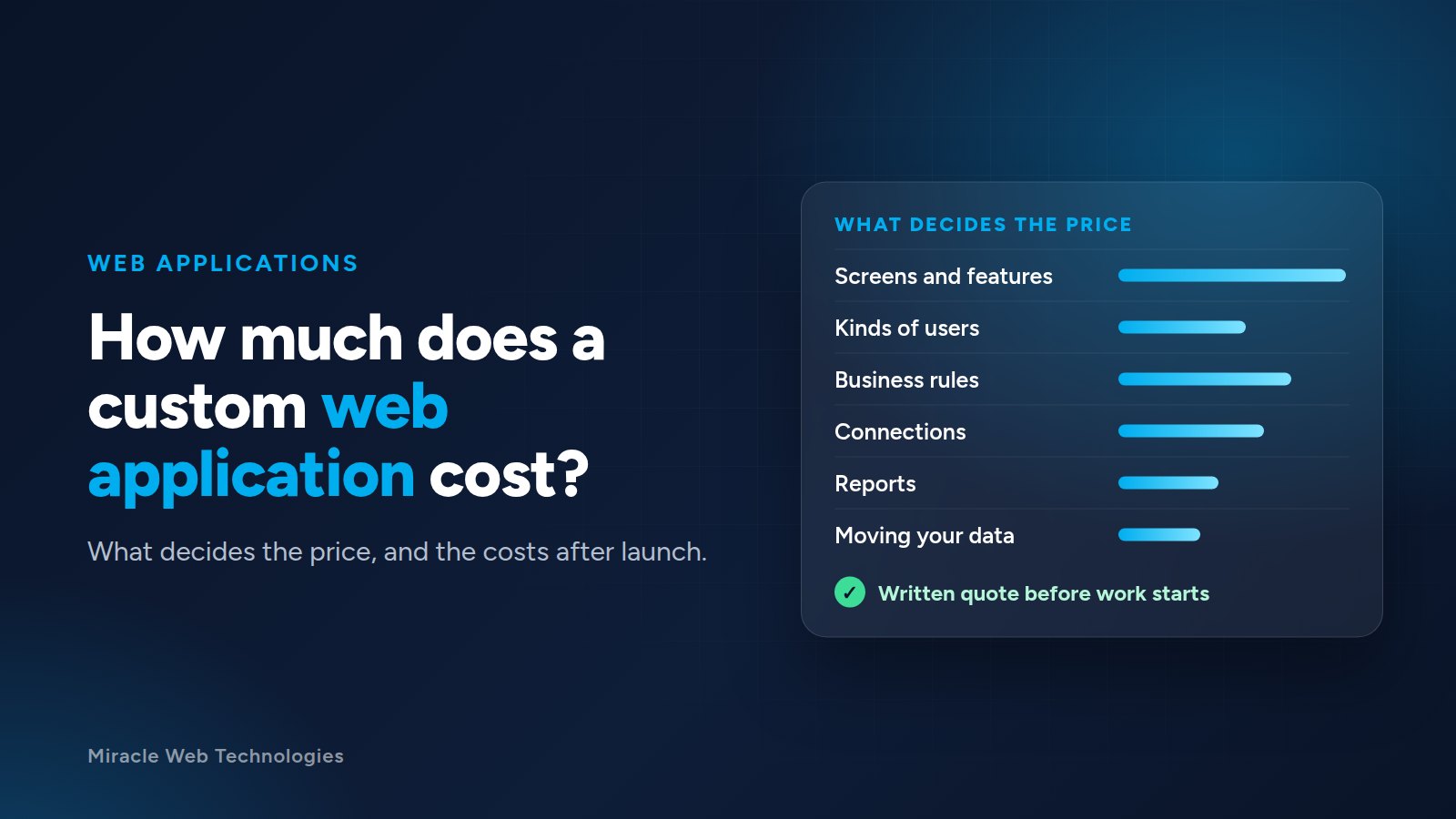
Developers price an application by the work it takes. Six things decide most of that work:
- Screens and features. Each list, form, search and page your users need is work to design, build and test. A system with ten screens costs less than one with fifty.
- Kinds of users. Customers, staff, managers and administrators often need different screens and different permissions. Each extra role adds work.
- Rules of your business. Discounts, approvals, stock levels, tax and how prices are worked out: the more rules the software must follow, the more it costs to build and test.
- Connections to other systems. Payment gateways, SMS and email services, accounting software and suppliers' systems each need their own work, and some have their own fees.
- Reports. Simple totals are quick; reports that combine data in many ways, or must match an accountant's format, take longer.
- Moving your existing data. Bringing in years of spreadsheets or data from an old system often needs cleaning and checking first.
Design matters too, but for most business applications clear and simple screens are worth more than custom artwork.
Three sizes of project
Every application is different, but most fall into one of three sizes. Knowing which one yours is helps you set a budget before you ask for quotes.
- A small tool. One job done well for one team: for example, booking appointments, recording orders taken by phone, or tracking jobs from start to finish. A handful of screens, one or two kinds of users, simple reports and few or no connections to other systems. Usually built and delivered in one go.
- A customer portal or business system. Your customers log in to see their orders, invoices or documents, and your staff manage them from an admin area. Several kinds of users, online payments, emails to customers and reports for managers. Usually delivered in two or three stages.
- A system that runs a whole part of the business. Several branches or departments, detailed permissions, connections to accounting software or suppliers' systems, and years of data to bring in. Best planned as a first version that covers the most important work, followed by further stages.
Moving up a size is rarely about one big feature. It is usually many small rules and exceptions that each need building and testing.
Three ways developers charge
- Fixed price. One price for an agreed list of features. You know the cost up front; changes to the list are quoted separately. Best when you know what you need.
- By the hour. You pay for the time actually spent. Flexible, and good for small changes or work that is hard to define in advance. Ask for timesheets so you can see where the hours went.
- A developer by the month. A developer works on your system for a set number of hours each month. Suits ongoing work on a system that keeps growing.
Why quotes for the same idea differ
It is common to get quotes for the same idea that are several times apart. Before choosing the cheapest or the most expensive, check what each one assumes:
- What is included. One quote may include testing, an admin area, emails and reports; another may leave them out and charge for them later.
- How detailed it is. A one-line price for "a customer portal" is a guess. A quote that lists the screens and features is based on what you actually need.
- Who builds it. A beginner, an experienced developer or a team with a project manager cost different amounts, and so do developers in different countries.
- What happens after launch. Some quotes include a period of free fixes, hosting or training; others do not.
- Ready-made or custom. Some developers adapt software they already have, others build everything for you. Both can be right, but you should know which you are getting and who owns it.
We wrote a separate checklist on what a good web development quote should include, with warning signs to look for.
How the payments are usually split
For most custom applications you do not pay everything up front. A usual arrangement is an advance before work starts, then the rest in stages, each tied to something you can see: an approved design, a working first version, or the finished system once it is live. Smaller fixed-price jobs are often split into two payments; larger projects into three or more. We explain the usual splits, and what happens if a project is cancelled, in how payment milestones work on a web project.
The costs after launch
The build is not the only cost. Plan for these as well:
- Hosting and the domain, every year.
- Maintenance: security updates, backups, and keeping the software working as browsers, PHP and other services change.
- Fees of other services the application uses, such as payment gateway charges or SMS credits.
- New features, because once a system is in use, people soon think of what else it could do.
A good quote tells you which of these are included and which are not.
How to keep the first version affordable
- Start with the part that saves the most time. Build that first, use it, then add the rest in stages. You start getting value sooner, and the later stages are based on real use, not guesses.
- Use ready-made pieces where they fit. Payment gateways, email services and proven frameworks are cheaper than building the same things from scratch.
- Write down how you work today. A short description of each step, with the forms, spreadsheets and reports you use now, makes quotes more accurate and saves paid hours later.
- Keep "nice to have" for later. List those features separately, so they do not raise the price of the first version.
What to send for an accurate quote
The more a developer knows, the less they have to guess, and guesses are usually priced in. A page or two covering these points is enough:
- What the business does, and the problem the application should solve.
- Who will use it: customers, staff, managers, and roughly how many of each.
- The steps of the work today, with examples of the forms, spreadsheets and reports you use.
- Other systems it must work with, such as a payment gateway or accounting software.
- Must-haves for the first version, and nice-to-haves for later.
- Any deadline, and the budget you have in mind, even a rough one.
Sharing a budget does not mean you will be charged all of it. It lets the developer suggest what fits within it, instead of quoting for a system you cannot use yet.
What we charge
We build web applications in PHP for businesses in India and abroad, and our own customer portal and billing system is one of them. Every project gets a written quote before any work starts, the code is yours once its invoices are paid, and larger systems can be delivered in stages. Our current starting price and usual timings are on the custom web application page; for smaller jobs or ongoing work, you can also hire a PHP developer by the hour or month.
Want an estimate for your idea? Describe what you do today and we will suggest the simplest system that fits, with a written quote.
Frequently asked questions
Can I get a fixed price for a web application?
Yes, once the features are agreed in writing. A fixed price covers the listed features; anything added later is quoted separately, so you always know the cost before work on it starts.
Can I start with a small version and add more later?
Yes, and it is usually the best way. Build the part that saves the most time first, use it, and plan the next stage from what you learn.
Who owns the code?
It should be stated in the quote. With us, the code is yours once its invoices are paid.
Is it cheaper to hire a developer abroad?
Rates differ from country to country, but the price is only part of it. Check that the developer writes clearly in English, shows progress regularly, and gives a written quote with the features listed. For clients abroad we quote in US dollars and confirm the payment method for your country with the quote.
Why does a developer need to know my budget?
With a budget, a developer can suggest what fits it: a smaller first version, ready-made parts, or a simpler design. Without one, the quote is for everything you mentioned, which may be more than you need now.

Comments