Many companies in the US, UK, Europe and Australia have their websites and web applications built in India. When it goes well, you get experienced developers, good value and work that continues while you sleep. When it goes badly, it is almost always for the same few reasons, and nearly all of them can be avoided before the first line of code.
Here are the ten things we agree with every client abroad before a project starts. Use them with whoever you hire.
1. A written scope and quote
Every page, feature and integration listed, with a fixed price or a clear hourly rate. "An online shop like X" is not a scope. Anything not on the list is a change, with its own price.
2. Milestones you can see
Split the work into stages, each with something you can open and click, and pay per stage. You never pay far ahead of what you have seen working.
3. Currency and payment method
Agree the currency (US dollars, pounds, euros or rupees), the method (PayPal, card or bank transfer) and who pays the fees and exchange costs. Surprises here sour good projects.
4. Who owns the code
The finished work should be yours once it is paid for, in writing. Check what is excluded: paid plugins, themes or the developer's own reusable tools usually come with a licence rather than ownership.
5. Access to the source code
Ask for the code in a repository (such as GitHub or Bitbucket) you can access during the project, not a zip file at the end.
6. Accounts in your name
Your domain, hosting, payment gateway and email service should be registered to your business, with the developer given access. If you part ways, nothing is held hostage.
7. Time zones and updates
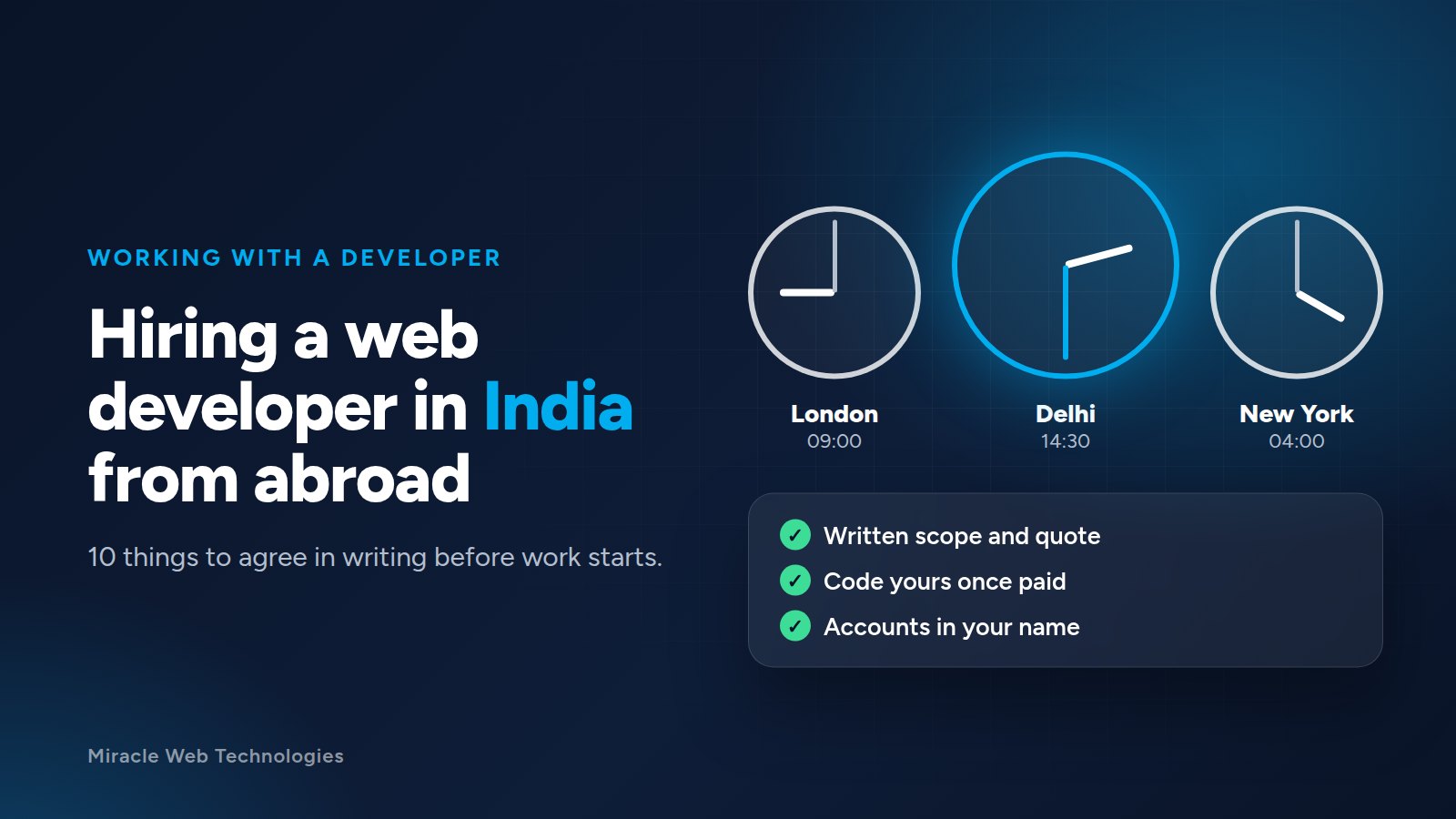
India is 3.5 to 5.5 hours ahead of the UK and most of Europe, and 9.5 to 13.5 hours ahead of the US, depending on daylight saving. Agree a regular overlap hour for calls, a weekly written update, and one channel for questions, so nothing gets lost between email, chat and calls.
8. A test site and acceptance
New work goes to a test (staging) site first. Agree how long you have to check each stage and what counts as finished, so "done" means the same to both sides.
9. Your customers' data
If the site handles personal data of people in the EU or UK, the EU GDPR or UK GDPR may apply. Agree how data is stored, who can access it, and that test copies do not leave real customer data lying around.
10. Support after launch
Websites need updates, backups and the occasional fix. Agree up front what happens after launch: a warranty period for bugs, and a maintenance plan or hourly rate for everything else.
Working with us
Miracle Web Technologies has built websites, online shops and web applications from Delhi for 11 years, for clients in India and abroad. You get a written quote before work starts, the code is yours once its invoices are paid, and every client has a portal for invoices, payments and support tickets. Clients abroad can pay in US dollars by PayPal. Tell us about your project and we will send you a scope and quote.